Why Most MVPs Fail After Launch
Created on · Last updated

Why Most MVPs Fail After Launch
And what the surviving ones do differently
You finally built that idea, you developed it into something market ready, shipped it properly, and waited. The result you got looked nothing like what you'd imagined. A trickle of signups, some polite feedback, and a graph that refuses to go up and to the right. The MVP is live, but it isn't alive. This is the silent graveyard nobody talks about. We celebrate the launch, but no one anticipates the early death.
Most MVPs don't fail because of bad execution. They fail because of a fundamental misunderstanding of what an MVP is actually for and because the mistakes that kill them are almost always made before the first user ever signs in.
What an MVP is actually for
The concept was never meant to be a shortcut to revenue. As Eric Ries defined it, an MVP is “that version of a new product which allows a team to collect the maximum amount of validated learning about customers with the least effort,” a vehicle for learning, not launching. A minimum viable product (MVP) is the smallest thing you can build to test a specific assumption about your market.
But somewhere along the way, the idea got distorted. "MVP" became a euphemism for "unfinished product." Teams started treating the launch as the finish line instead of the starting gun.
The moment you stop treating your MVP as an experiment, it becomes just a bad product.
What MVP failure actually looks like
Before getting into causes, it's worth being precise about what failure means here. An MVP hasn't failed simply because it didn't go viral or convert everyone who signed up. A true MVP failure happens when:
- You launch and learn nothing useful
- Users reject the core value, not just the execution
- You burn through runway before confirming whether the idea has legs
- You're forced to rebuild large parts of the product because early assumptions were never tested
In short, an MVP fails when it costs more than it teaches. That outcome is far more common than founders expect and the underlying causes are almost never quickly detected.
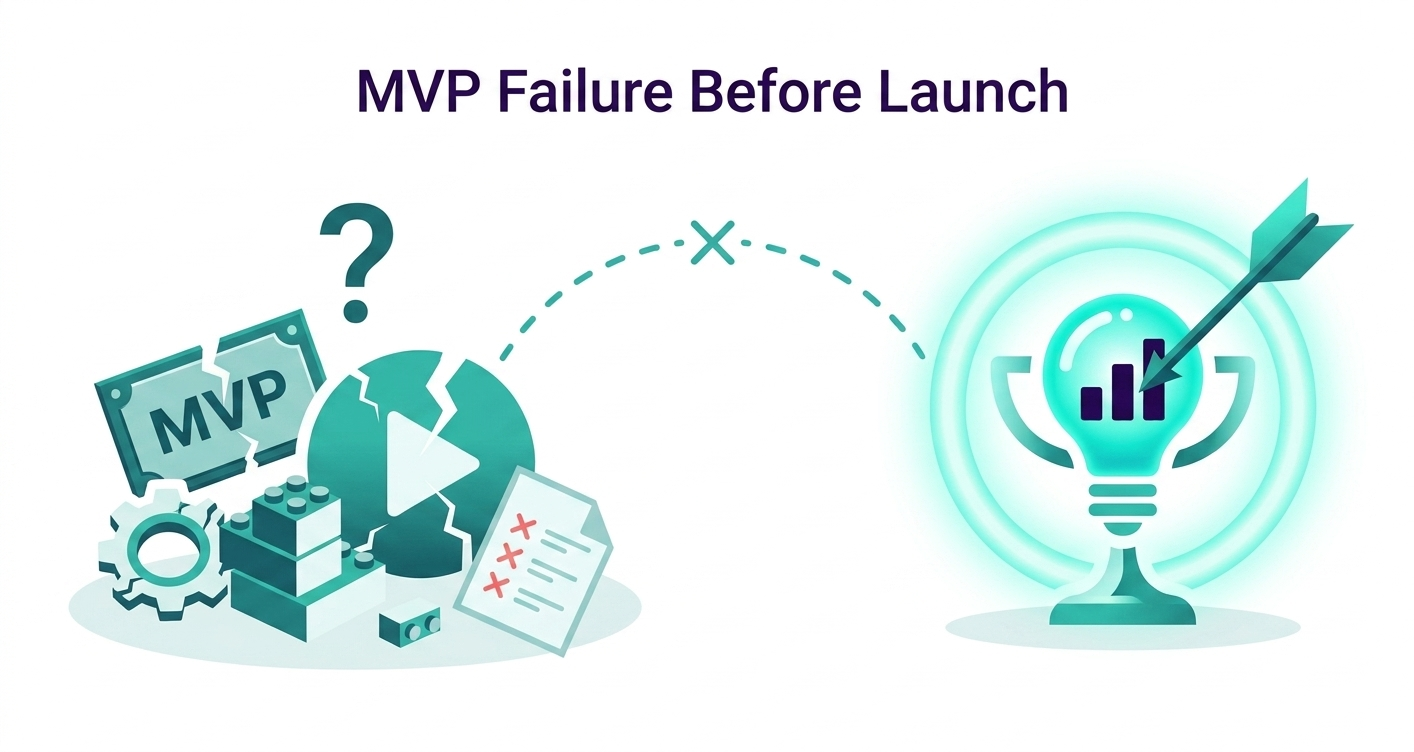
The Top Reasons MVPs Fail After Launch
1. The problem wasn't painful enough
This is the most common reason MVPs fail, and the hardest to accept. The product works, it solves a real problem, but the problem isn't painful enough to make people change their behavior.
CB Insights analyzed 431 failed VC-backed companies and found that 43% failed due to poor product-market fit, not running out of money, which is almost always a symptom rather than the cause. The underlying disease is that not enough people cared.
People have a remarkable tolerance for inconvenience. They'd rather use spreadsheets in place of ‘a better tool’ if that tool doesn't do what it was created for; make lives and processes easier. They'd stick with clunky workflows because switching has a cost: cognitive, financial, and habitual. If your MVP doesn't address a pain sharp enough to cut through that inertia, it will politely die.
There's a useful test for this. Ask whether people are already trying to solve the problem with something worse — duct-taped spreadsheets, workarounds, manual processes. If they're not improvising a solution, the urgency probably isn't there. Urgency, not interest, is what makes people adopt a new product.
What to do instead: Before writing a line of code, look for evidence of the workaround. Talk to potential users and ask not "would you use this?" but "what do you do today when this problem happens?" The answer to that question is more useful than any survey. This is exactly the kind of structured thinking that Enyata's workshops are designed to surface, aligning what teams want to build with what users actually need before a single sprint begins.
2. The "minimum" killed the "viable"
Teams confuse cutting features with cutting value. An MVP is minimum and viable. Both words matter equally, and failing either one is fatal.
When you strip a product down so aggressively that users can't experience the core promise, you've built something ‘minimum’ but not viable. You're asking people to imagine what the product could become, and not to experience it in what they currently hold, and most won't.
The opposite failure is just as common: the MVP that's too polished. Six months of refinement on an assumption that was never validated. By the time you learn you were wrong, the runway is gone.
Teams that suffer this never validated people's actual needs, they simply built what they thought the market needed.
What to do instead: Define the one thing your product must do for a user to get real value, and build only that. Resist the temptation to ship a second feature until the first one has been validated. Embarrassment at the state of v1 is a sign you're doing it right.
3. There was no plan for what to measure
Launch is not a feedback event. It's the beginning of a conversation (only if you've built the infrastructure to hear the reply).
Most MVPs launch without any systematic mechanism for capturing what's actually happening: why users signed up, what they tried to do first, where they got stuck, and why they never came back. Without that, you're iterating on instinct.
One CB Insights study found that 14% of startup failures were directly tied to ignoring customers. That number understates the problem, because ignoring feedback often masquerades as other causes of death downstream — "we ran out of money" is usually the moment a product without feedback finally stops pretending.
The way to succeed is to pick one metric before launch, which often should be activation, not acquisition. This is where you should ask, "Did the user do the thing that indicates they got value?) and instrument everything around it. Watch session recordings. Talk to churned users. Treat every support email as a data point.
What to do instead: Before launch, write down the specific user action that would prove your core hypothesis. Not "did they sign up" but "did they complete X." Build your analytics around that action. Everything else is noise until you understand that one thing.

Beyond the core three, there are additional factors that often accelerate failure or make recovery harder. They often look like these:
They launched to the wrong people first
There's a specific kind of early customer who will tolerate an incomplete product in exchange for early access or the novelty of being first. These are your early adopters, and they are not representative of the mainstream market you eventually need to capture.
The failure mode: you optimise your MVP for the people who are already sold on the idea. You make the onboarding friendlier for technical users. You build the features the enthusiasts ask for. Then you discover that the wider market (the people who need to be convinced) won't touch it.
This is how products end up with passionate small communities and growth ceilings they can never break through. The early adopters loved it. The mainstream never came.
What to do instead: Consider the most random user's disposition to your product. That's your real test user. If your MVP works for them, it will almost certainly work for the enthusiasts too. Optimising in the other direction leaves you with a product that only enthusiasts will ever use.
The unit economics were never looked at
Growth can kill a company. It sounds paradoxical, but it's one of the most reliable MVP failure modes: you scale before you've figured out whether the business works at scale.
The Startup Genome Project studied over 3,200 high-growth tech startups and found that 74% of internet startups fail due to premature scaling. Startups that scale properly grow around 20 times faster than those that scale prematurely, but the ones that scale too soon rarely survive to find out.
An MVP that acquires customers at $80 and generates $30 in lifetime value will fail faster as it "succeeds." The launch obscures this because costs look fixed and early revenue feels like proof of concept. It isn't until you push on the gas that the real math becomes visible, and by then, the runway is almost gone.
What to do instead: Before you optimise for growth, establish two numbers: what it costs to acquire a customer (CAC) and what a customer is actually worth over their lifetime (LTV). If LTV is meaningfully higher than CAC, you have a business. If it isn't, more growth is just accelerating the problem. For teams that need support pressure-testing these numbers and building a product architecture that can actually sustain scale, Enyata's product development service is built specifically for this stage. We're your best bet for rapid product builds that are engineered to survive traction, not collapse under it.
The team stopped learning and started executing
There's a particular thing that happens after launch: the roadmap fills up, everyone has ideas. The product team wants to ship the features they had planned before the launch data came in. The pressure to "keep momentum" crowds out the patience required to actually understand what the data is saying.
This is the post-launch trap. The MVP told you something. It may not have told you what you expected, but it told you something, and the most dangerous thing you can do is ignore that signal in favour of the plan you made before you had evidence.
The teams that fail treat the MVP launch as validation. The teams that succeed treat it as the first sentence of a longer conversation with the market. They remain genuinely curious about what users are doing, rather than just looking for confirmation that the strategy was right.
What to do instead: Schedule a mandatory learning review two to four weeks after launch, before anyone ships a new feature. Make the questions explicit: what did users actually do? Where did they drop off? What did churned users say when you called them? The answers should determine the next sprint, not the pre-launch roadmap.
Nobody owned retention
Acquisition is seductive; the curve goes up, people are signing up, the team celebrates new user numbers. But, users are leaving just as fast as they're arriving, and nobody is watching the back door. Retention is the metric that separates products people find useful from products people try once. It's also the hardest to fix, because poor retention is almost always a symptom of a deeper problem: the product doesn't deliver on its promise fast enough or at all.
Bureau of Labor Statistics data shows roughly 20% of new businesses fail within the first two years, rising to around 45% by year five, and weak retention accelerates that curve dramatically. If your MVP has retention problems, no amount of growth spend will save it. You're filling a leaky bucket.
What to do instead: Track retention from day one, even when the numbers are small. If week-two retention is under 20%, don't run acquisition campaigns; they'll only expose more users to a product that isn't working yet. Fix the core experience first. Retention before growth, always.

What Surviving MVPs Do Differently
The MVPs that make it through don't necessarily have better products at launch. They have better processes after launch.
They define success before they ship. "Did people sign up" isn't the question they ask, rather, they ask "did people do the specific thing that proves they got value?" They talk to users constantly, not just during launch week. They are honest about what the data actually says, even when it contradicts the plan. They treat failure as information rather than verdict.
A low conversion rate isn't a failed product, it's an answer to a question you weren't sure about. The real failure is not asking the question clearly enough to extract an actionable answer.
The clearest pattern across successful MVPs is this: the founders are more curious about being wrong than they are invested in being right.
A Pre-Launch Checklist Worth Keeping
Most of the failures above are preventable if you ask the right questions before you ship.
- What specific assumption are we testing? Not "will people use this?" Try something falsifiable, like "project managers will pay $29/month to eliminate status update meetings." They may not pay as much, but they definitely will, and it's in that you find results.
- What would prove us wrong? Define failure before launch, not after. If fewer than 10% of users complete the core action in the first session, that's a signal.
- Who is our test audience? Early adopters or skeptics? If you can only get enthusiasts to use it, that tells you something.
- What does activation look like? The single action that means a user got real value. Write it down before you launch.
- How will we hear from churned users? Not just active users. The people who left are the most informative ones in your entire user base.
- Do the unit economics work, even roughly? CAC and LTV don't need to be precise at MVP stage, but they need to point in the right direction.
In Conclusion…
Shipping your MVP is not an achievement. It's permission to start learning.
If this is misunderstood, the team involved would spend their post-launch energy defending what they built. The teams that get it spend that same energy trying to understand what their users actually need and then go ahead to build that instead.
Most MVPs fail after launch because they were built to prove an idea, not to test one. The question worth asking before you ship isn't "is this ready?" It's "what would we need to learn to know if this is worth continuing?"
At Enyata, we've worked with early-stage startups, scaling businesses and enterprises across Africa, helping them move from idea to validated product without the expensive detours. Whether you need help defining what to build before you build it, or a team to build and ship it fast, our full range of product and engineering services is designed to get you to real answers, faster.
Everything else follows from that.
OUR EVENTS
Join Our Events & Programmes
Our events bring industry leaders together to share insightful knowledge. Replay the sessions with our previous guests and register to join upcoming events.


Copyright © Enyata 2026. All rights reserved. Privacy Policy


