How to Help Your Employees Embrace Process Automation
Created on · Last updated

Process automation is one of the fastest ways to increase efficiency, reduce costs, and free up your team to focus on strategic work. But despite its benefits, many automation initiatives stall because employees resist them. Overcoming that resistance is critical to unlocking the full value of your investment.
At Enyata, we have seen first‑hand that automation is as much a cultural challenge as it is a technical one. This article dives deeper than typical guides. You will learn not only why resistance happens but also how to build an automation strategy that empowers employees, delivers measurable ROI, and becomes a catalyst for innovation.
Why Employees Resist Automation
Resistance is rarely about rejecting technology. It usually reflects fear, uncertainty, and negative past experiences. Here is a deeper look at why it happens:
Fear of Job Loss and Role Redundancy
Employees often assume automation equals downsizing. Even when the goal is to free them from repetitive tasks, the lack of a clear message fuels anxiety. This fear is stronger in industries where layoffs have followed technology upgrades.
Change Fatigue and Trust Deficit
When employees experience frequent tool changes, restructuring, or leadership shifts, they become weary. Trust in management decisions erodes, and even beneficial initiatives meet skepticism.
Misaligned Incentives
If employees are rewarded for speed or output in a manual process, they may see automation as a threat to their ability to meet KPIs or earn bonuses.
Knowledge and Skill Gaps
Automation platforms often require new skills such as data interpretation, exception handling, or system monitoring. Employees who feel unprepared may resist to protect their competence and reputation.
Poorly Designed Rollouts
Resistance also happens when automation is introduced without proper testing, resulting in workflows that break or slow down operations. A bad first impression creates lasting opposition.
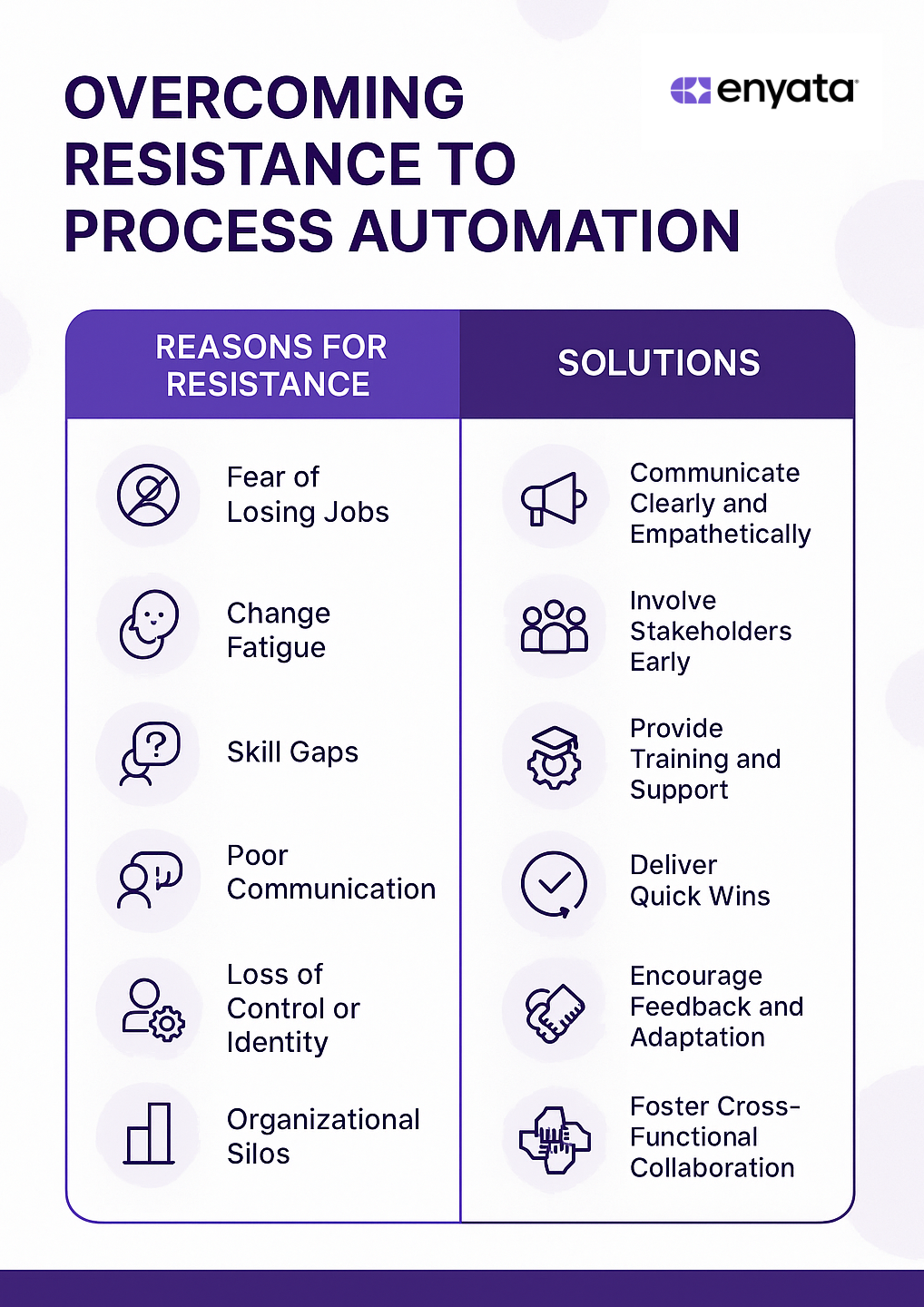
Strategies to Overcome Resistance
Automation adoption improves dramatically when organizations treat it as a change management initiative rather than just a technology deployment. Here is a proven framework used by Enyata:
1. Build a Strong Business Case
Communicate clearly how automation supports business goals. Use real data: how many hours will be saved, how error rates will drop, and how teams will benefit. Quantifying the impact helps employees and executives see automation as an investment rather than an experiment.
2. Co‑Create Solutions with Employees
Instead of designing automation software in isolation, involve employees early. Conduct process discovery workshops, map current workflows, and let employees highlight inefficiencies. When they see their ideas reflected in the final solution, they are more likely to adopt it.
3. Prioritize Human‑Centered Design
Good automation complements human work rather than replacing it. Ensure the new workflows are intuitive, reduce cognitive load, and improve the employee experience. Automations that are hard to use will be bypassed.
4. Provide Role‑Based Training
Offer different training for frontline employees, process owners, and managers. Go beyond how to use tools and teach how to interpret data, escalate issues, and continuously improve automated processes.
5. Start Small, Then Scale
Pilot automation in one department or for one process. Choose a high‑visibility pain point so results are obvious. Document before‑and‑after metrics, share them widely, and use that success to gain momentum for larger rollouts.
6. Establish Continuous Feedback Loops
Create clear channels for employees to report issues and suggest improvements. Act on that feedback quickly. When employees see their input leading to refinements, trust grows.
7. Align Leadership and Incentives
Leaders should model the desired behavior by using the automated workflows themselves. Adjust performance metrics so employees benefit from using automation instead of feeling penalized.
Measuring Success Beyond Cost Savings
Many organizations measure automation only by cost reduction, but broader metrics show its true impact:
- Employee Productivity: Measure time freed for strategic work.
- Error Rate Reduction: Track improvements in quality and compliance.
- Customer Experience: Monitor faster turnaround times and satisfaction.
- Employee Engagement: Survey staff on workload balance and job satisfaction post‑automation.
- Scalability: Track whether the business can handle more transactions or customers without increasing headcount proportionally.
Frequently Asked Questions
Will automation take away jobs?
Not necessarily. In many cases, it redefines roles rather than eliminates them. Employees can focus on problem‑solving, decision‑making, and customer engagement instead of repetitive tasks.
- What processes should be automated first?
Start with repetitive, rule‑based tasks that have high volume and measurable ROI. Examples include invoice processing, employee onboarding workflows, or customer support ticket routing. - How can we keep automation reliable?
Assign process owners responsible for monitoring performance and updating workflows as business needs evolve. Proactive governance prevents automation from becoming obsolete.
Why Partner with Enyata
Implementing automation successfully requires technical skill and a deep understanding of people. Enyata specializes in helping businesses identify the right processes to automate, design solutions that are easy to adopt, and manage organizational change to reduce resistance.
We deliver:
- Process discovery and mapping workshops
- Custom automation solutions tailored to your workflows
- Change management support and employee training
- Ongoing optimization to ensure long‑term ROI
If you are ready to transform your operations with automation that employees embrace, connect with Enyata today.
OUR EVENTS
Join Our Events & Programmes
Our events bring industry leaders together to share insightful knowledge. Replay the sessions with our previous guests and register to join upcoming events.


Copyright © Enyata 2026. All rights reserved. Privacy Policy


