Fintech in Africa: Market Opportunities and Barriers to Success in 2026
Created on · Last updated
.png)
Africa is one of the fastest-growing fintech regions globally. With a young, tech-savvy population and limited access to traditional banking, the continent presents a massive opportunity for digital finance. More than half of the world’s mobile money accounts are based in Africa, and the number of fintech startups continues to increase every year.
But opportunity does not mean it is easy. The African fintech market is full of promise, yet it also presents real challenges. From regulatory complexity to infrastructure gaps, companies face significant barriers when they try to establish and scale their solutions. Understanding these challenges and knowing how to overcome them can make the difference between failure and long-term success.
In this article, we examine the primary challenges fintech businesses encounter in Africa and the strategies that can enable them to thrive.
Navigating Complex Regulations
One of the biggest challenges in Africa is the fragmented regulatory environment. Each country has its own central bank rules, compliance requirements, and licensing structures. Nigeria’s Central Bank regulates payment providers differently from Kenya’s Central Bank, while South Africa follows a completely separate framework.
This lack of harmonization means that expanding into multiple countries is not a straightforward process. Companies must study, understand, and comply with different sets of laws, which can be expensive and time-consuming. Licensing delays are common, and the cost of staying compliant can put a strain on young businesses.
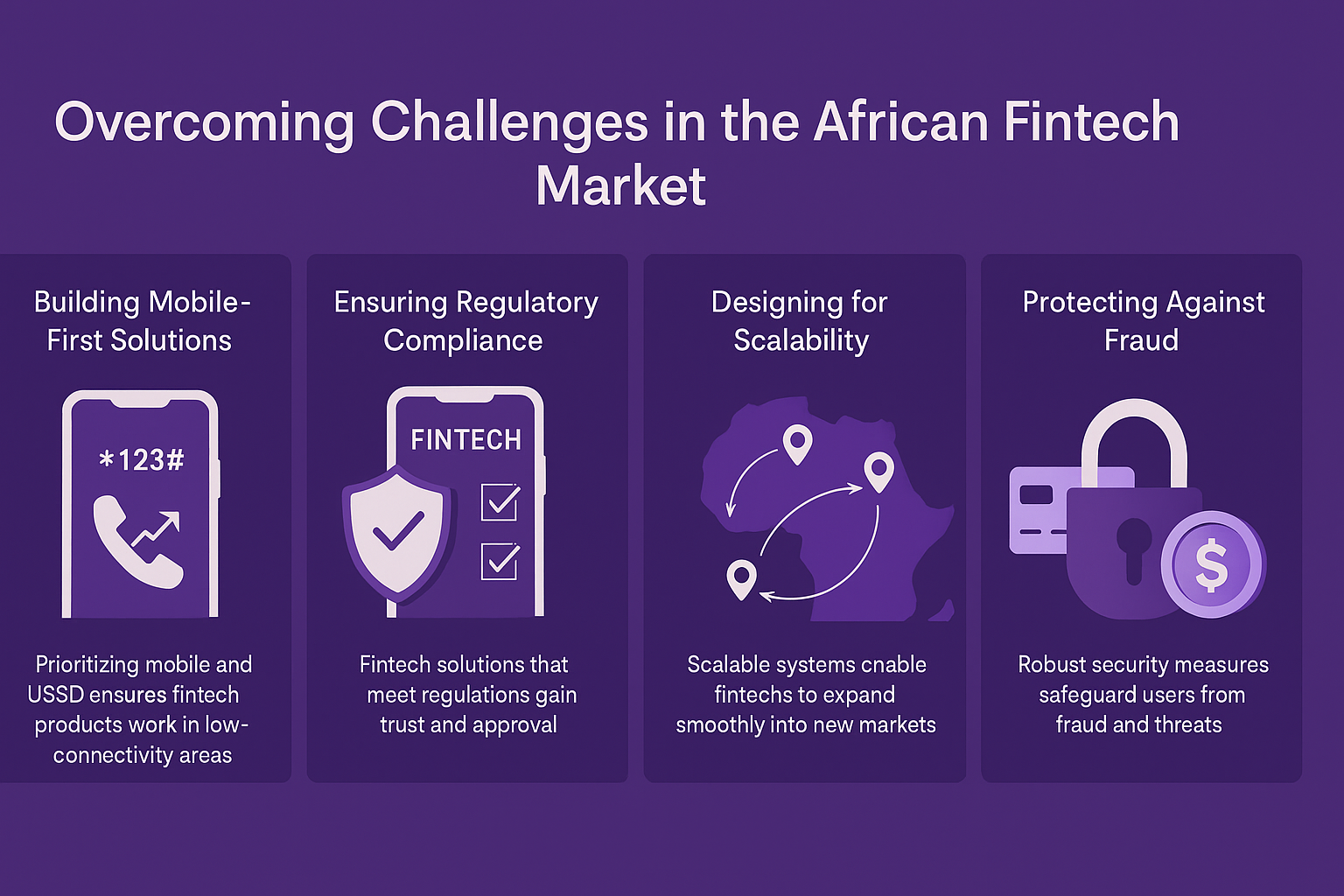
To overcome this, companies need to work with local legal and compliance experts who understand the landscape in each market. Building relationships with regulators also helps create trust and can make approvals move faster. Fintechs should also design compliance systems that are flexible enough to adapt quickly to changes in regulations across different jurisdictions.
Building Trust with Customers
Trust is another major issue in the African fintech space. Many customers remain skeptical about digital financial services because of fraud, data breaches, and poor experiences with unreliable providers in the past. In rural and semi-urban areas, low levels of financial literacy make this skepticism even stronger.
Without trust, even the most innovative product will struggle to gain adoption and retain users.
To win customer trust, fintechs must put security first. Strong encryption, two-factor authentication, and fraud detection tools should be standard. Transparency also matters. Companies that communicate clearly about their fees, processes, and data usage stand a better chance of gaining loyalty. Partnering with trusted local brands, banks, or telecom providers can also boost credibility quickly. At the same time, providing financial education and simple onboarding guides helps customers understand and feel comfortable with the product.
Addressing Infrastructure Gaps
Although mobile adoption is growing rapidly, Africa still faces infrastructure challenges. Inconsistent internet coverage, unreliable electricity in some regions, and limited smartphone penetration create real barriers to delivering smooth financial services.
Fintech companies need to design solutions that put mobile first, since phones are more common than computers. Platforms must be easy to use on mobile and should even support USSD services for customers who do not own smartphones. Offering features that work offline or in low-bandwidth conditions can also make a big difference. Finally, partnerships with mobile network operators can help expand reach because telecom companies often have better infrastructure networks than startups.
Intense Competition and Market Saturation
The fintech boom in Africa has led to a crowded market. From payment platforms to lending apps, there are hundreds of players competing for the same users. Larger companies already dominate in some areas, making it difficult for new entrants to stand out.
The best way to compete is not to copy existing solutions but to differentiate. Startups can focus on niche offerings such as small business financing, agriculture, or cross-border remittances, where gaps still exist. A great user experience also sets companies apart.
Platforms that are easy to navigate, quick to respond, and reliable will always have an advantage. Above all, tailoring solutions to local cultural, linguistic, and market contexts ensures that customers see real value in the product.
Access to Funding and Scaling Challenges
Accessing funding is a persistent issue for many fintechs. While investment into African fintech has grown, much of it goes to the “big four” markets of Nigeria, Kenya, South Africa, and Egypt. Startups in smaller markets often struggle to secure financing.
Even when funding is available, scaling across multiple African countries comes with its own challenges. Every market requires resources, operational expertise, and strategies that fit local needs.
To address this, fintechs need to target a wide variety of investors. Venture capital firms are one option, but development finance institutions, impact investors, and local angel networks should not be overlooked.
Startups should aim to prove traction early, since strong user adoption and revenue potential give investors confidence. When it comes to scaling, a phased approach works best. Instead of expanding everywhere at once, it is wiser to dominate one or two key markets before moving into new regions.
Cybersecurity Risks
As digital payments and mobile money continue to grow, cybercrime has also increased. Hackers actively target fintech platforms to steal customer data and funds. A single breach can damage customer trust permanently and lead to fines from regulators.
The solution is to take cybersecurity seriously from day one. Companies must invest in advanced protections like firewalls, fraud detection, and encryption. Regular audits and security testing ensure that weaknesses are identified before they can be exploited. Customers also need to be educated about safe practices, such as how to recognize phishing scams or secure their accounts.
Talent Shortages
The African fintech industry faces a shortage of skilled professionals. Finding software developers, cybersecurity experts, and compliance officers is difficult and expensive, as demand outpaces supply. Retaining top talent is also a challenge in such a competitive market.
Startups can overcome this by investing in training programs that build fintech expertise internally. Remote work opportunities also allow companies to tap into global pools of talent rather than limiting themselves to local hires. Creating a strong company culture is equally important. Offering clear growth opportunities, flexible working conditions, and a purpose-driven mission makes companies more attractive to top talent.
Turning Challenges into Opportunities
The African fintech market is full of potential, but it is not easy to enter. Businesses face real challenges with regulation, infrastructure, funding, competition, and trust. Yet these hurdles are not barriers to success. They are opportunities for companies that are willing to adapt, innovate, and work closely with local markets.
The fintechs that succeed in Africa are the ones that combine technology with a deep understanding of the market. By focusing on trust, building strong partnerships, investing in customer education, and staying flexible, businesses can transform challenges into opportunities for growth.
Africa’s financial future is digital, and fintech companies that rise to meet these challenges will play a defining role in shaping that future.
OUR EVENTS
Join Our Events & Programmes
Our events bring industry leaders together to share insightful knowledge. Replay the sessions with our previous guests and register to join upcoming events.


Copyright © Enyata 2026. All rights reserved. Privacy Policy


