Custom Software vs Off-the-Shelf: Which Delivers Better ROI for Enterprises?
Created on · Last updated
.png)
Have you ever tried wearing a “one-size-fits-all” t-shirt? It might fit, but it never really feels right. The sleeves are either too long, the neckline is awkward, or it hugs in all the wrong places.
Off-the-shelf software works the same way. Sure, it covers the basics, but when your business has unique needs, that generic fit can quickly become uncomfortable.
Now imagine having a shirt tailored to your exact measurements. It feels better, looks sharper, and lasts longer. That’s what custom enterprise software does for your business. Instead of forcing you to adapt to rigid features, it’s designed around your workflows, challenges, and goals.
In this article, we’ll explore why custom enterprise software consistently outperforms off-the-shelf solutions and why more organizations are choosing tailored technology to drive growth, efficiency, and innovation.
Understanding the Difference
Off-the-shelf software refers to ready-made applications designed to serve a wide range of businesses. These are pre-packaged solutions with standardized features, often marketed as “one-size-fits-all.” Examples include accounting software, generic CRM tools, and project management platforms.
Custom enterprise software, in contrast, is tailored to a specific organization. It is built with the company’s processes, goals, and industry requirements in mind. Instead of adapting your operations to fit the software, the software adapts to fit you.
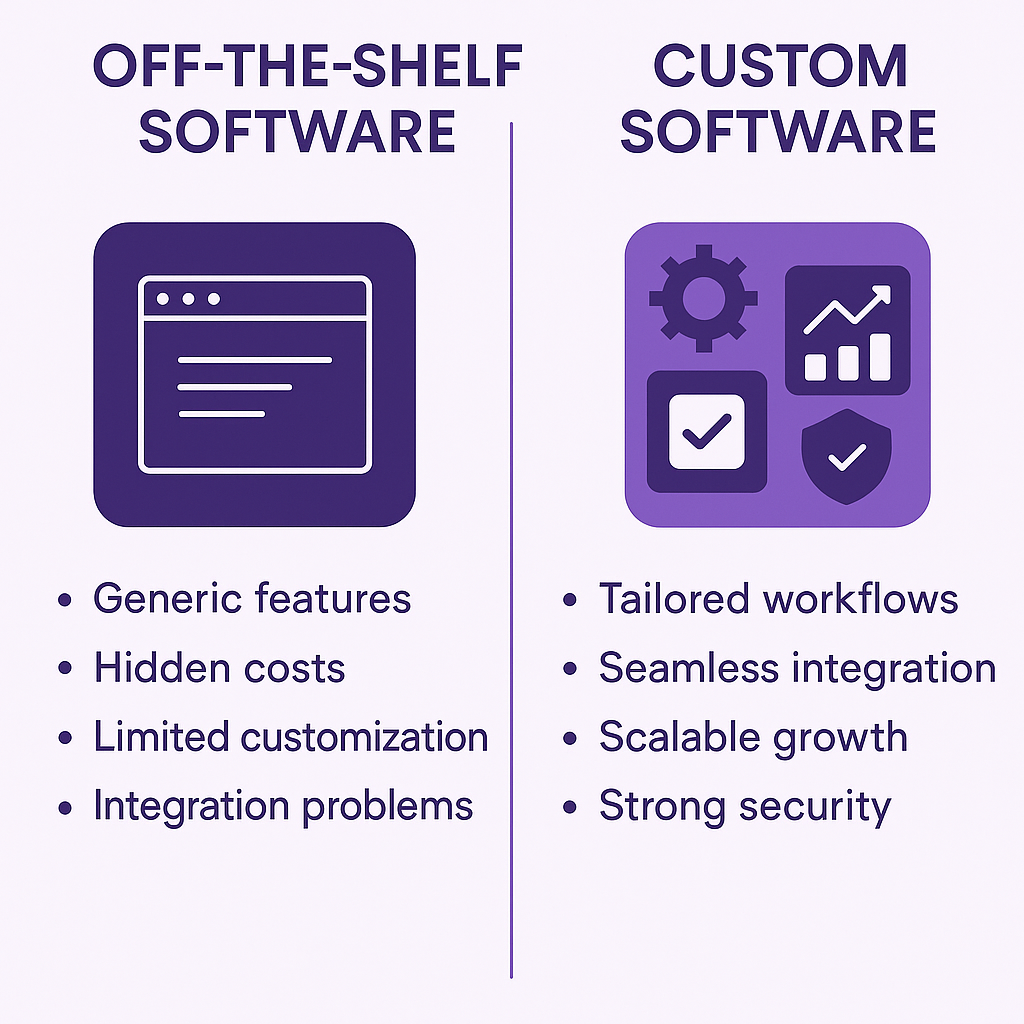
Why Off-the-Shelf Software Falls Short
At first glance, off-the-shelf solutions seem appealing. They are widely available, easy to install, and usually less expensive upfront. However, they often create more problems than they solve in the long run.
- Limited Customization
Off-the-shelf platforms rarely account for the unique workflows of a business. Companies are forced to adapt their processes to fit the software, which can lead to inefficiencies, duplication of effort, and employee frustration.
- Integration Challenges
Most enterprises rely on multiple systems — finance, HR, supply chain, sales, and customer support. Generic solutions are not always compatible with existing tools, leading to data silos and operational bottlenecks.
- Hidden Costs
While upfront costs may seem low, off-the-shelf solutions often require expensive add-ons, ongoing licensing fees, and constant upgrades to meet evolving needs. Over time, the total cost of ownership can far exceed that of a custom system.
- Scalability Issues
Businesses grow and evolve, but many off-the-shelf solutions cannot scale effectively. As transaction volumes increase or new markets are entered, performance slows and limitations become glaring.
- Security Concerns
Pre-packaged software is widely used, making it a bigger target for hackers. Updates may not be timely, and businesses must rely on the vendor’s priorities instead of having full control over data security.
The Advantages of Custom Enterprise Software
Custom enterprise software eliminates the compromises of off-the-shelf systems. By aligning technology directly with organizational needs, businesses unlock significant competitive advantages.
1. Tailored to Business Needs
Custom software is designed around your workflows, not the other way around. Every feature serves a clear purpose, ensuring efficiency and user satisfaction. For example, a healthcare provider can integrate patient data management, regulatory compliance, and billing into one seamless system, instead of juggling multiple disjointed apps.
2. Seamless Integration
Enterprises rarely operate in isolation. Custom software can integrate with existing platforms — whether it’s an ERP system, payment gateway, or analytics dashboard. This creates a unified environment where data flows smoothly across departments, reducing silos and errors.
3. Scalability for Growth
Custom enterprise software grows with your business. Whether expanding into new markets, adding new services, or handling larger transaction volumes, the system can scale without disruptions. This makes it a long-term investment that supports sustainable growth.
4. Stronger Security and Compliance
Every industry faces unique regulatory challenges, from GDPR in Europe to HIPAA in healthcare or PCI DSS in finance. Custom enterprise software can be designed with built-in compliance features and advanced security protocols, giving businesses peace of mind.
5. Cost Efficiency Over Time
Although custom development requires higher upfront investment, it eliminates recurring licensing fees and reduces the need for expensive workarounds. The long-term cost savings, combined with improved efficiency, make it a smarter financial decision.
6. Competitive Advantage
In a crowded market, differentiation is key. Custom solutions allow businesses to innovate, create unique customer experiences, and gain a strategic edge. Unlike competitors tied to generic tools, companies with tailored systems can move faster and adapt quickly to change.
How to Decide If Custom Software Is Right for You
Custom enterprise software is not always the right choice for every organization. Startups or very small businesses may benefit from low-cost off-the-shelf solutions until they scale. However, for enterprises with complex processes, regulatory requirements, or growth ambitions, custom systems provide a clear advantage.
When evaluating your options, consider:
- Do compliance requirements demand stricter control over processes?
- Are integration challenges leading to data silos?
- Do you anticipate significant growth in the coming years?
- If you are bending your operations to suit your software instead otherwise.
If you answered “yes” to any of these, it may be time to explore custom enterprise solutions.
Enyata’s Approach to Custom Enterprise Software
At Enyata, we specialize in building custom enterprise software that empowers businesses to achieve more. Our team works closely with clients to understand their challenges, design scalable solutions, and integrate seamlessly with existing systems. From financial compliance to healthcare data security, we build software that not only solves problems but also unlocks opportunities.
By leveraging modern technologies such as artificial intelligence, machine learning, and cloud infrastructure, we ensure that our solutions are future-ready. The result is software that adapts as your business grows, keeping you competitive in a rapidly evolving market.
Some Frequently Asked Questions We Get (FAQ)
1. What is the key difference between custom and off-the-shelf enterprise software?
Custom enterprise software is built specifically for your business — designed to match your workflows, goals, and industry requirements. Off-the-shelf solutions are generic, pre-made tools meant for a wide range of users, which often forces businesses to adapt their processes to fit the software.
2. Is custom enterprise software more expensive than off-the-shelf solutions?
Not necessarily. While custom development costs more upfront, it usually offers better return on investment (ROI) over time. Off-the-shelf tools often involve recurring license fees, paid upgrades, and workflow inefficiencies that increase long-term costs.
3. How long does it take to build custom enterprise software?
Development timelines depend on project complexity. A basic solution may take 3–6 months, while larger enterprise systems can take 9–12 months or more. The process is typically phased, allowing you to start using key modules early while the rest is built out.
4. Can custom software integrate with existing systems?
Yes. Seamless integration is one of the biggest advantages of going custom. The software can connect directly with CRMs, ERPs, analytics tools, or legacy databases, which eliminates data silos and improving cross-departmental efficiency.
5. How does custom enterprise software enhance security and compliance?
Custom software gives you full control over security architecture, user permissions, and data encryption. It can also be designed to comply with industry-specific regulations such as GDPR, HIPAA, or PCI DSS, reducing compliance risks.
6. When should a company consider switching from off-the-shelf to custom software?
You should consider going custom if your current tools cause integration challenges, data silos, or process inefficiencies. It’s also the right move if you anticipate rapid growth, operate under strict compliance rules, or want a unique competitive advantage.
7. What ongoing support does Enyata provide after software deployment?
Enyata offers continuous maintenance, performance monitoring, and feature enhancements after launch. We ensure your software stays secure, scalable, and aligned with your evolving business needs — so your investment continues to deliver value long-term.
The Future Belongs to Custom Solutions
As industries continue to digitize, the limitations of off-the-shelf systems will only become more apparent. Enterprises need agility, security, and scalability to thrive, which are qualities that custom software delivers best.
The question is no longer whether you can afford to invest in custom enterprise software. The real question is whethyeahher you can afford not to.
With Enyata as your partner, you gain more than just a software provider. You gain a strategic ally committed to building technology that fits your business perfectly and positions you for long-term success. Reach out to us to get started.
OUR EVENTS
Join Our Events & Programmes
Our events bring industry leaders together to share insightful knowledge. Replay the sessions with our previous guests and register to join upcoming events.


Copyright © Enyata 2026. All rights reserved. Privacy Policy


